Content Research


1) What are asthma and its main symptoms?
2) How
asthma affects the fitness of the human body?
3) How
can an asthma attack be treated?
4) Discuss the trend in the
number of people being diagnosed with asthma
5) How will the treatment of
asthma improve in the future?
How
has this research developed your documentary idea?
1) What are asthma and its main symptoms?
Asthma
is a respiratory condition that affects approximately 5.4 million people in the
United Kingdom. It affects 1 in 12 adults and can be developed at any age. It
should be noted that there is no cure to asthma and treatments are simply to
control the condition. Asthma is “a condition that still kills over 1,000
people every year in the UK.”
It is
a lung disease that causes breathing difficulties through inflammation, which
narrows the airways of the bronchi. The immune system identifies harmless
substances such as dust and triggers an increase of white blood cells to the
airways. This leads to inflammation in the airways and they become narrowed leading
to difficulties in breathing.
http://www.nhs.uk/news/2015/04April/Pages/Asthma-cure-within-five-years-researchers-hope.aspx
In
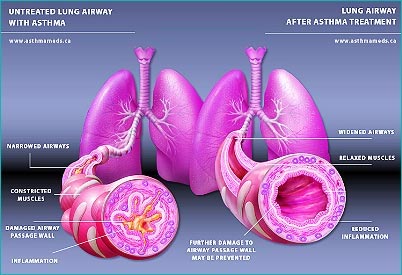
this diagram we can view the walls of the bronchi in a normal airway compared
to a person that has asthma. During asthma the walls of the bronchi thickens
which result to less oxygen being inhaled.
"The
main symptoms of asthma are:
•
Wheezing
•
Shortness of breath
•
Tight chest
•
Coughing"
I
found this information from a reliable source using the NHS website.
2) How asthma affects the fitness of
the human body?
Exercise
is generally seen in a positive healthy light. Its main benefits are that it reduces
cardiovascular heart disease and helps deals with obesity related problems.
However some people find that exercise triggers their asthma. As you breath in
from the nose, the air is warmed however during physical exercise people tend
to breathe through the mouth where the air is not warmed. This can irritate the
airways and lead to asthma.
Exercise
induced asthma can be triggered by any form of exercise.
“You
know that exercise has triggered asthma symptoms and you need to stop if you:
•
Start
coughing/wheezing
•
Are
gasping for air/very short of breath/can't get enough air
•
Feel
tightness in the chest
•
Have
trouble speaking in short sentences
Younger children may complain that their
chest or tummy hurts”
http://www.asthma.org.uk/advice-trigger-exercise
There
are many examples of sports stars that have been diagnosed with asthma. An
example is David Beckham who has suffered from mild form of asthma since
childhood. Another example is Paul Scholes who raised thousands of pounds for
the National Asthma Campaign as well as featuring in an asthma UK campaign to
encourage children to exercise.
http://www.independent.co.uk/sport/football/news-and-comment/beckhams-asthma-gives-inspiration-1826827.html
3) How can an asthma attack be treated?
“Asthma attacks kill three people each day. The UK has one
of the highest asthma death rates in Europe.” As quoted from the NHS website http://www.nhs.uk/Livewell/asthma/Pages/Asthmaattacks.aspx
First step to dealing with an asthma attack is to
recognize the symptoms of an attack:
An asthma attack occurs if:
· The inhaler is not providing any relief
· You have the symptoms of an asthma e.g. coughing, tight chest, shortness
of breath
· You are consuming oxygen at a faster rate than usual
A medical consultant who is
working at GlaxoSmithKline provided this information.
The following steps should treat
an asthma attack:
“1. Take one to two puffs
of your reliever inhaler immediately.
2. Sit down and try to
take slow, steady breathes.
3. If you do not start to
feel better, take two puffs of your reliever inhaler (one puff at a time) every
two minutes. You can take up to 10 puffs.
4. If you don't feel
better after taking your inhaler as above, or if you are worried at any time,
call the ambulance.
5. If an ambulance
doesn't arrive within 10 minutes and you are still feeling unwell, repeat step
3.”
From the video link below it
explains the importance of getting the asthma patient to relax and be in a
comfortable position. It is essential
that the patient does not panic and takes slow deep breaths before using their
inhaler.
As you can see from above during
an asthma attack the airways is contracting the most hence why the person
suffering from an asthma attack usually struggle to breathe as the volume of
oxygen that can enter the airway is very low.

As you can see from above during
an asthma attack the airways is contracting the most hence why the person
suffering from an asthma attack usually struggle to breathe as the volume of
oxygen that can enter the airway is very low.
4)
Discuss the trend in the number of people being diagnosed with asthma

http://icp.giss.nasa.gov/education/urbanmaap/projects/projects_asthma3.html
From this diagram we can see that
the number of population being diagnosed with asthma is increasing over the
years. There are many possible reasons as to why asthma patients are increasing
for instance environmental factors affecting genetic. An example of this is
from a study based on pregnant rats being exposed to nicotine, which resulted
to the younger generation of rats having higher risk of getting asthma. It should be noted that only the first
generation of rats were smoking but this caused the younger generation of rats’
lungs to be narrowed.
Another explanation for the
increasing trend of asthma population is the increase of air pollution. Air
pollution consists of nitric oxide and other substance, which are likely to
cause asthma. It should be noted that the increase in asthma patients affects
both genders.
The diagram below shows the
increase in air pollutants over the years which correlates to the number of
increasing asthma patient.

Other possible reasons for the
increase in number of people being diagnose with asthma could be due to the
increase in smoking.
“It turns out that smoking during
pregnancy or exposure to secondhand smoke during pregnancy could be asthma
causes for infants.”
Smoking damages the cilia in the airways,
which is used to protect the airways from dust and other harmful bacteria. When
the cilia become damage it allows dust and mucus to accumulate in the airways.
Also second hand smoking can cause a child to develop asthma, as it is an
asthma trigger.

5) How will the treatment of asthma improve in the future?
At present there is no known cure
for treating asthma. Asthma patients are provided with asthma inhalers to take
regularly, which simply reduce the symptoms of asthma.
However there may be hope of a
cure for asthma in the future. A large amount of research is being put towards
identifying the mechanisms of the disease. In fact, GlaxoSmithKline and the
Medical Research Council have set up a £4 million program to analyze links
between allergy and asthma attacks.
I
have been researching how asthma treatments will develop over the next 10
years. A recent study has proven that calcium-sensing receptors causes asthma.
A drug called Calcilytics could help asthma patients by reversing the effects
of asthma.
"If
we can prove that calcilytics are safe when administered directly cato the lung
in people, then in five years we could be in a position to treat patients and
potentially stop asthma from happening in the first place," Dr. Daniela
Riccardi from Cardiff University explained in the press release.
As
we can see from the diagram, calcilytic drug ensures that the airways in the
lungs do not contract or thicken.
How has this research developed
your documentary idea?
My
idea of researching into asthma was due to the fact I felt the condition was
very undermined and an issue that people were not taking seriously. There are
other diseases such as cancer or HIV/AIDS, which are given much more investment
as they have their promotional adverts yet asthma, is often overlooked. I
wanted to raise awareness of the disease and provide people with the knowledge
of how to deal with an asthma attack. Asthma is starting to gain more
recognition due to events such as World Asthma Day but as a sufferer of Asthma
myself; I wanted to do my part.
